


Who should attend this webinar?
Anyone who works in a professional care role or supports people through all forms of loss and grief. Our content is applicable to a wide variety of professions including counsellors, social workers, teachers, emergency response teams, medical, corrections, mental health, hospice, volunteers, caregivers and more.
Overview
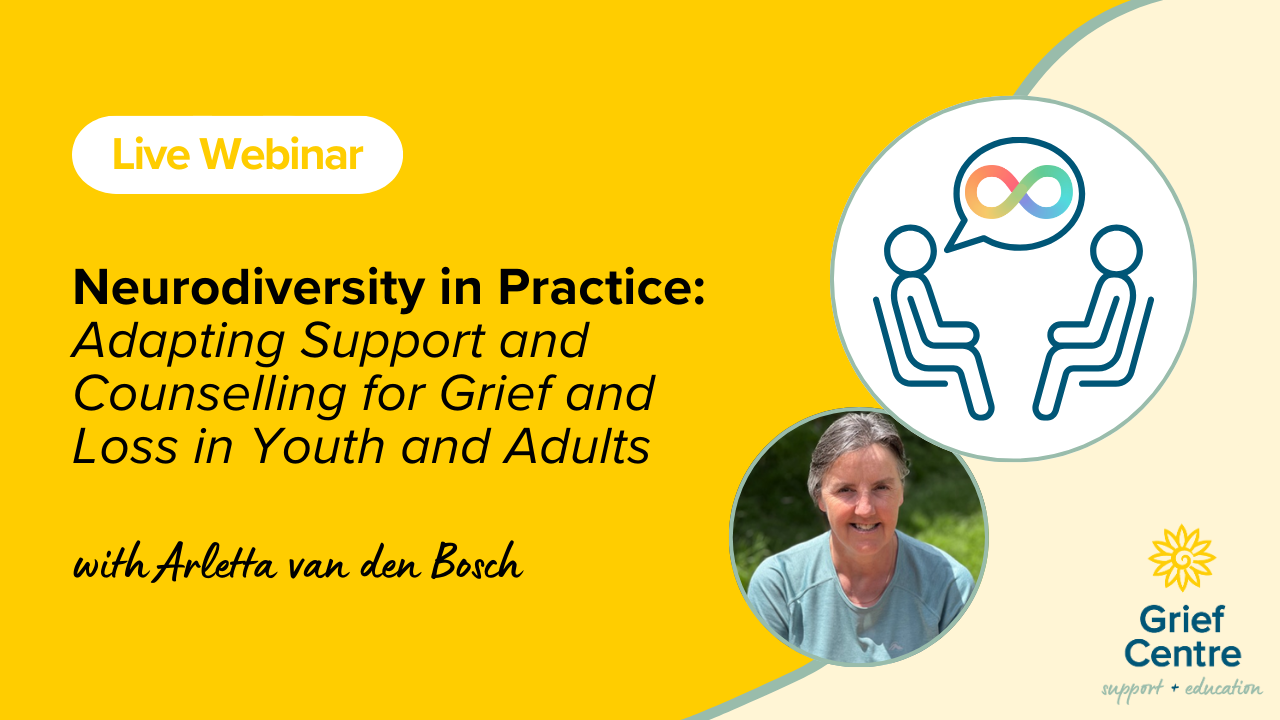
Processing the world differently is not a problem if we move away from neurotypical expectations and traditional ways of counselling, supporting, and teaching. In this training, we will briefly explore the strengths and challenges neurodivergent youth and adults often experience, and how neurodivergence influences their processing and life experiences. We will also examine a framework that can support making your practices more accessible and suitable for neurodivergent clients, whether in counselling or in other support roles.
There is currently limited research on neurodiversity and loss or grief. When supporting neurodivergent clients through loss and grief, you may encounter unexpected behaviours or perspectives. We will discuss what the existing research says and share available resources. Drawing on experience, I will also share examples of what different processing can look like when supporting neurodivergent clients experiencing loss and grief.
* As this training focuses primarily on practical strategies rather than theory alone, a prior basic understanding of autism, ADHD, dyslexia, etc. will be helpful.
Key learning points
-
A brief overview of neurodiversity and current terminology.
-
Common strengths and challenges experienced by neurodivergent people.
-
Differences in processing and how these may present in daily life and support settings.
-
Ways to adapt your practice to better support neurodivergent youth and adults.
-
Neurodiversity and loss and grief, including:
-
Current research related to neurodiversity and loss and grief.
- Differences we may observe in how grief is experienced and expressed.
- Practical strategies to support neurodivergent youth and adults experiencing grief.
- Approaches to supporting families alongside neurodivergent individuals.
- Relevant resources to support practice and further learning
-
Webinar registration details
- Access to the live two-hour webinar
- Access to the webinar recording for 30 days
- Access to a downloadable PDF handout
- Certificate of accomplishment issued on completion of a short quiz for CPD/OPD points
- NOTE: Webinar times are shown in NZST or NZDT. If you’re joining us from Australia, please use a time-zone converter to see the live time in your state.
Certificate of accomplishment
We can provide a certificate of accomplishment for all our training courses. The requirement for receiving a certificate to confirm professional development is as follows:
- You must view a minimum of 80% of a live-presented webinar workshop or
- You must view a minimum of 80% of a recorded webinar workshop
- You must complete a short quiz on the webinar content
CPD points/credits
We are accredited to provide points/credits to the following organisations, educational institutes, and associations:
Australia
AROH
Our training is endorsed or recommended by the following organisations, educational institutes, and associations:
New Zealand
NZAC
DAPAANZ
CANZ
NZSDRT
Australia
ACWA
ACA (Australian Counselling Association)
To receive your CPD points/credits, you will need to receive a certificate of accomplishment which you can then provide to your relevant institution.
FAQs
I can't make the live time, can I still watch?
All registered participants will receive a link to the recording to catch up. It will be available for 30 days.
Who is the Presenter?
Arletta van den Bosch (she/her/ia)
Originally from the Netherlands, Arletta van den Bosch has been a counsellor for 22 years and has specialised for the past 14 years in supporting autistic youth and adults, their whānau, and communities. She holds a Master’s degree in Autism Studies, with a focus on autism and anxiety. Last year, she completed a postgraduate qualification in Neurodiversity, with a focus on adults and on neurodiversity within the Criminal Justice System.
Arletta runs a busy private practice offering neuro-affirmative support to autistic and other neurodivergent young people and adults, as well as their families and communities (including workplaces and schools). She regularly provides training on understanding and supporting autistic and other neurodivergent people in education, mental health, community, and workplace settings.
In her training sessions and workshops, Arletta combines lived-experience perspectives from neurodivergent people, current research, and insights gained from many years of supporting neurodivergent clients. Her sessions are interactive and practical, with a strong focus on neurodivergent strengths alongside support needs. All training is tailored to the specific situations and questions of each organisation or group.
Organisations Arletta has trained recently include St John, Whenuapai Airbase, Gymnastics New Zealand, Aviation NZ, Auckland Council Events, RTLB, and numerous schools.
Arletta is a contractor for Oranga Tamariki and the Ministry of Education, is a full member of NZAC, and participates in various autism and neurodiversity peer groups.


October, 2026
Monday
August 26,2019
- Tuesday
- 9:00am - 10:00am
Awesome Job!
We have received your appointment and will send you a confirmation to your provided email upon approval.
Get in touch
 Your request has been submitted successfully.
